When Napoleon Made the Dutch Choose Surnames — And Some Chose 'Born Naked'
In 1811, the Dutch had to register surnames for the first time. The names they chose — wise, defiant, and sometimes obscene — are still there today.
Here's a fact that sounds made up but isn't: there are people in the Netherlands right now — real, living, passport-carrying people — with the surname Naaktgeboren. It means "born naked." There are families named Poepjes ("little poops"). Zeldenthuis ("rarely home"). Rotmensen ("rotten people"). Gekkehuis ("madhouse").
This is Napoleon's fault. Or rather, it's the fault of a decreet (decree, /deh-KRAYT/) he signed in 1811 — and the stubborn, creative, possibly drunk Dutch farmers who responded to it.
The Netherlands Before Surnames
Before 1811, most Dutch people — especially in the northern provinces — didn't have fixed surnames. They used patroniemen (patronymics, /pah-troh-NEE-mun/): your father's first name became your last name. Jan, son of Pieter, was Jan Pieters. Pieter, son of Hendrik, was Pieter Hendriks. Your achternaam (surname, /AKH-tur-nahm/) changed every generation.
This worked perfectly well for villages where everyone knew everyone. It did not work for an empire that needed to collect belasting (taxes, /beh-LAHS-ting/) and conscript soldiers. Napoleon's bureaucrats couldn't tax "Jan Pieters" when there were fifteen Jan Pieters in every town and the name changed each generation.
Het Decreet — The Decree of 1811
On August 18, 1811, the decree arrived: every person in the empire must register a fixed family name. The process was called the naamsaanneming (name adoption, /NAHMS-ahn-nay-ming/) — literally, the "name-taking." An ambtenaar (civil servant, /AHM-tuh-nahr/) sat at a desk in each town hall. You told him your name. He wrote it in a leather-bound register. Done.
The naamsaanneming mostly affected the northern provinces — Friesland, Groningen, Drenthe, and Overijssel — where patronymics were still common. Most people in Holland and the south already had fixed surnames.
De Grap — The Joke (Maybe)
Here's where the story gets fun. According to popular legend, many Dutch families assumed Napoleon's occupation was temporary. The French would lose — they always did eventually — and the names would be forgotten. So they treated the whole thing as a grap (joke, /KHRAHP/).
The Names They Chose
🇳🇱 Naaktgeboren (NAHKT-kheh-boh-run) — "born naked"
🇳🇱 Poepjes (POOP-yuhs) — "little poops"
🇳🇱 Zeldenthuis (ZEL-dun-TOYS) — "rarely at home"
🇳🇱 Zonderkop (ZON-dur-kop) — "without a head" (headless)
🇳🇱 Dodeman (DOH-duh-mahn) — "dead man"
🇳🇱 Rotmensen (ROT-men-sun) — "rotten people"
🇳🇱 Gekkehuis (KHEK-uh-HOYS) — "madhouse"
🇳🇱 Donderwinkel (DON-dur-WINK-ul) — "thunder store"
🇳🇱 Spring in 't Veld (SPRING int FELT) — "jump in the field"
🇳🇱 Uittenbroek (OYT-un-brook) — "out of his pants"
🇳🇱 Piest (PEEST) — "to urinate"
🇳🇱 Borst (BORST) — "breast"
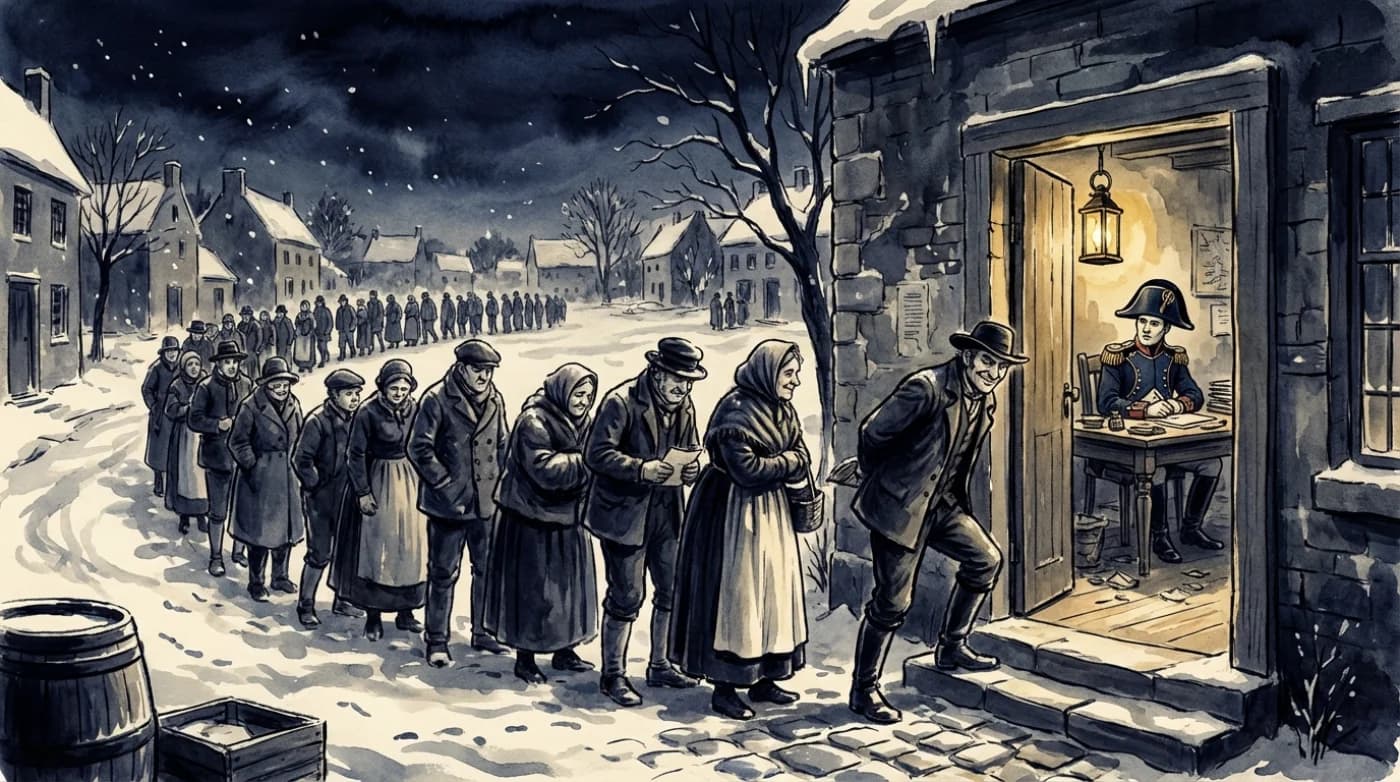
You can imagine the scene in a Frisian village hall in December 1811. A French ambtenaar sits behind a desk. A line of farmers waits. One steps forward. "Your name?" the official asks. The farmer grins. "Naaktgeboren." The pen writes. Next in line. "Poepjes." The pen hesitates. Then writes.
De Waarheid — The Truth (It's Complicated)
This is a beloved Dutch story. It's also — according to some taalkundigen (linguists, /TAHL-kun-dih-khun/) — at least partly a myth.
The reality is more nuanced. Some etymologists argue that "Naaktgeboren" doesn't actually mean "born naked" — the naakt may derive from nach, an old Germanic word meaning "after." A Naaktgeboren was someone born after their father died — a posthumous child. Not a joke. A tragedy.
Similarly, many "funny" Dutch surnames may have had perfectly sensible origins in dialect, occupation, or geography that simply sound ridiculous to modern ears. The Dutch — as a Reddit thread in r/learndutch puts it — "made the best possible story out of their own history."
What We Know For Sure
- Napoleon's 1811 decree and the naamsaanneming are documented historical fact
- Many northern Dutch had no fixed surnames before this
- Names like Naaktgeboren, Poepjes, Zondervan, Borst DO exist today
- The original naamsaanneming registers survive and can be viewed at Tresoar in Leeuwarden
- Whether the names were intentionally funny is debated by scholars
De Erfenis — The Inheritance
Napoleon lost. The French left in 1813. The Netherlands became a koninkrijk (kingdom, /koh-NINK-rayk/) under Willem I. But in 1825, the Dutch government made one quiet, devastating decision: the names would stay. Anyone who hadn't registered yet had to do so now.
What was tijdelijk (temporary, /TY-duh-luk/) became permanent. The joke — if it was a joke — became an erfenis (inheritance, /AIR-fuh-nis/). If your great-great-grandfather chose Zonderkop in 1811, thinking the French would be gone by spring, that name followed his children. And their children. And their children's children. It's still in Dutch phone directories today.
There were also names that weren't jokes at all — just honest:
Occupations
Bakker — baker
Visser — fisherman
Smit — smith
De Boer — the farmer
Self-Promotion
De Groot — the great/large one
Den Beste — the best
De Koning — the king
De Jonge — the younger
What This Teaches About Dutch
The naamsaanneming story is a perfect Dutch lesson disguised as history. In one story, you learn:
- achternaam — surname (achter = behind/after, naam = name)
- naamsaanneming — name adoption (naam + aanneming = taking on)
- decreet — decree (a French-origin word that stuck)
- ambtenaar — civil servant (hear the guttural A)
- erfenis — inheritance (a word that carries weight in Dutch history)
- tijdelijk — temporary (ironic, given what happened)
- belasting — taxation (the reason for the whole thing)
That's 7 Dutch words, learned in context, anchored to a story you won't forget. No flashcards needed.
The full story — with all 12 vocabulary words, pronunciation audio, Delft Noir paintings, and quiz challenges — is now an Amsterdam Tale in the Wander Languages app. It's called Napoleons Namenlijst — Napoleon's Name List. You can walk to the Royal Palace on Dam Square where the decree was processed, or visit the original registers at Tresoar in Leeuwarden.
Ready to start learning?
Episode 1 is free. No signup required. Just tap and begin.
Start Episode 1 Free →