A Walking Tour Through 400 Years of Amsterdam
10 real locations that tell the story of Amsterdam — with Dutch vocabulary rooted in the place where history happened.
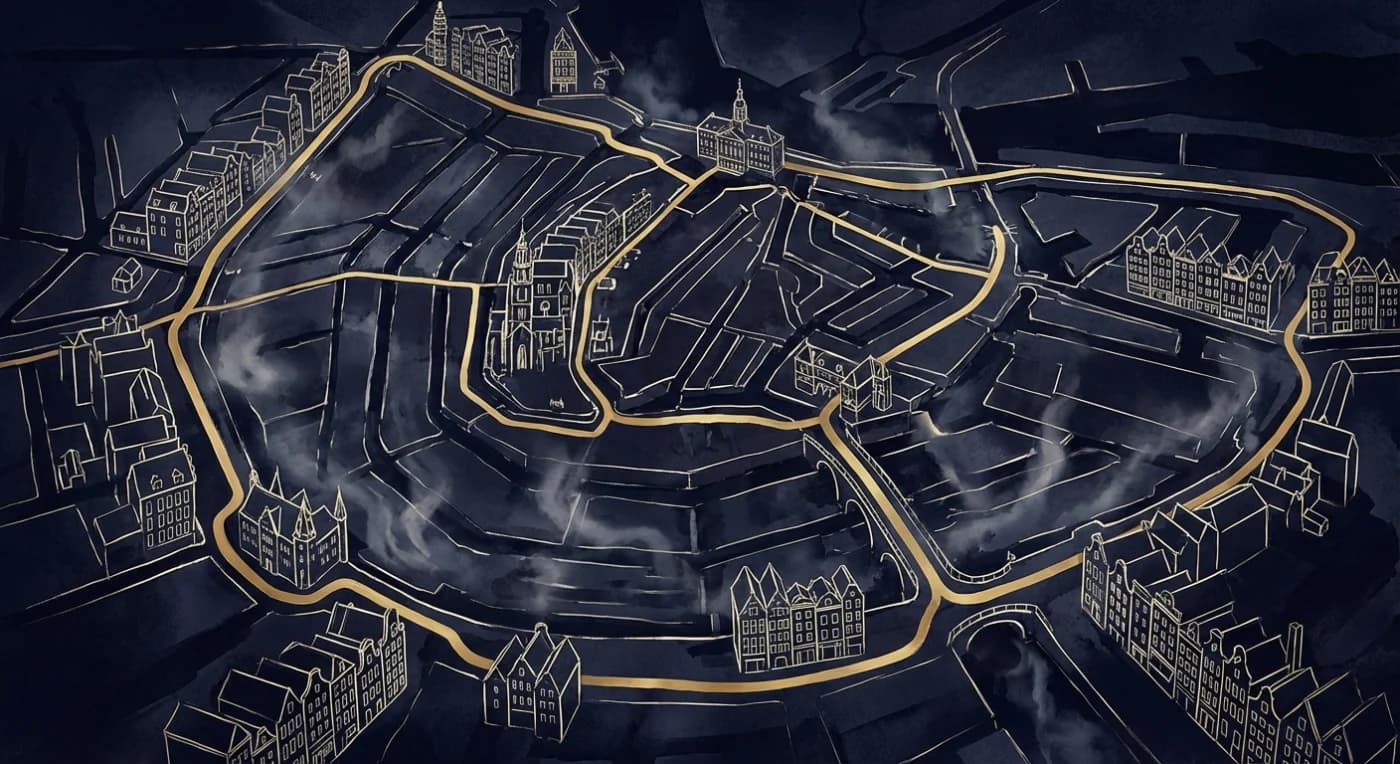
Amsterdam is a city that tells its own story — if you know where to look. Every canal bridge, every hidden courtyard, every gabled façade is a chapter in a 700-year saga of water, trade, rebellion, and reinvention.
This walking tour covers 10 stops across 400 years of Amsterdam history. At each stop, you'll learn Dutch words that belong to that specific place — words that carry the weight of what happened there. This is how story-based learning works — and why it's 3× more effective than flashcards.
The Route
1. Het Mirakel — Nieuwe Kerk (1345)
In 1345, a dying man in a house on the Kalverstraat received the last sacraments. He vomited. The hostie (communion wafer) was thrown into the fire. The next morning, it was found in the embers — completely intact. The mirakel (miracle) transformed Amsterdam from a fishing village into a pilgrimage city. The Nieuwe Kerk was built to house the relic, and the street where it happened — the Kalverstraat — became Amsterdam's most important road.
🇳🇱 mirakel (MEE-rah-kul) — miracle · hostie (HOS-tee) — communion wafer
2. The Damrak — Where Elsje Arrived (1664)
In the Golden Age, the Damrak was Amsterdam's harbour mouth — packed with ships, fish stalls, and cheap lodging houses. In April 1664, an 18-year-old Danish girl named Elsje Christiaens arrived here as a vreemdeling (stranger), looking for work as a meid (maidservant). Two weeks later, unable to pay huur (rent), she killed her landlady with a bijl (axe). Rembrandt rowed across the IJ to sketch her body on the gallows. He never explained why.
🇳🇱 vreemdeling (VRAYM-duh-ling) — stranger · bijl (BYL) — axe · huur (HYOOR) — rent · Read Elsje's full story →
3. Het Spinhuis — Spui (1597)
Above the entrance to the Spinhuis, Amsterdam carved an inscription: "Schrik niet, ik wreek geen kwaad maar dwing tot goed" — "Fear not, I avenge no evil but compel to good." Inside, women were forced to spinnen (spin) yarn for up to 16 hours a day. The word straf (punishment) was carved into the city's architecture.
🇳🇱 spinnen (SPIN-nun) — to spin · straf (STRAHF) — punishment · dwingen (DWING-un) — to compel
4. De Jordaan — Palingoproer (1886)
In the summer of 1886, the working-class neighbourhood of the Jordaan erupted. Residents had been pulling paling (eel) from the canals on ropes strung across the water — illegal, but traditional. When the politie (police) tried to stop it, the menigte (crowd) fought back. The Eel Riot lasted three days. Soldiers were called in. 26 people died. It was a class war that started with a fish.
🇳🇱 paling (PAH-ling) — eel · menigte (MEN-ikh-tuh) — crowd · politie (poh-LEET-see) — police
5. Tuschinski Theater — Reguliersbreestraat (1921)
Abraham Tuschinski, a Jewish immigrant from Poland, built what many call the most beautiful cinema in Europe. Art Deco, Jugendstil, and Amsterdamse School fused into one overwhelming verwachting (expectation). He was murdered in Auschwitz. His theater survived. It's still showing films. The tapijt (carpet) in the main hall alone cost more than most houses in 1921.
🇳🇱 verwachting (ver-VAKH-ting) — expectation · tapijt (tah-PAYT) — carpet
6. Het Achterhuis — Prinsengracht 263 (1942–44)
You know about the dagboek (diary). Everyone does. But do you know about the helpers? Miep Gies bought groceries for eight people while pretending to buy for two — for 761 days. Victor Kugler built a hinged boekenkast (bookcase) to hide the entrance. Bep Voskuijl managed the forged distributiebonnen (ration cards). This was verzet (resistance) — not with guns, but with filing cabinets.
🇳🇱 achterhuis (AKH-tur-HOYS) — back house · boekenkast (BOO-kun-kast) — bookcase · verzet (vur-ZET) — resistance
7. Vondelpark — De Kabouterbeweging (1970)
In 1970, five people wearing gnome hats won seats on Amsterdam's gemeenteraad (city council). Their manifesto: make the city autovrij (car-free), grow food in parks through stadslandbouw (urban agriculture), give power to buurthuizen (neighbourhood houses). Everyone laughed. Fifty years later, Amsterdam did all of it. The toekomst (future) agreed with the gnomes.
🇳🇱 kabouter (kah-BAUW-tur) — gnome · autovrij (AU-toh-FRAY) — car-free · toekomst (TOO-komst) — future · Struggling with these sounds? See our pronunciation guide →
8. NDSM Wharf — Amsterdam-Noord (1984–present)
When the shipyard closed, squatters moved in. They turned a rusting industrial werf (wharf) into one of Europe's largest cultural vrijplaatsen (free zones). Today NDSM hosts festivals, studios, and street art. The free ferry across the IJ is Amsterdam's best commute — and the view of the city skyline from the north shore hasn't changed since Rembrandt rowed across in 1664.
🇳🇱 werf (VAIRF) — wharf/shipyard · vrijplaats (FRAY-plahts) — free zone
Walk It Yourself
Every location on this map is a stop in Wander Languages. The app gives you GPS-guided walking routes, check-in points at each location, and the full story with vocabulary at every stop. The city becomes your classroom.
Episode 1 takes you through Amsterdam's first evening — from Central Station to the Jordaan — teaching you the words you'll hear in every café and canal-side conversation. It's free. No signup required.
Ready to start learning?
Episode 1 is free. No signup required. Just tap and begin.
Start Episode 1 Free →