Why Learning Dutch Through Stories Actually Works
Forget flashcard apps. Science says narrative context, emotional anchoring, and spatial memory make vocabulary stick 3× better.
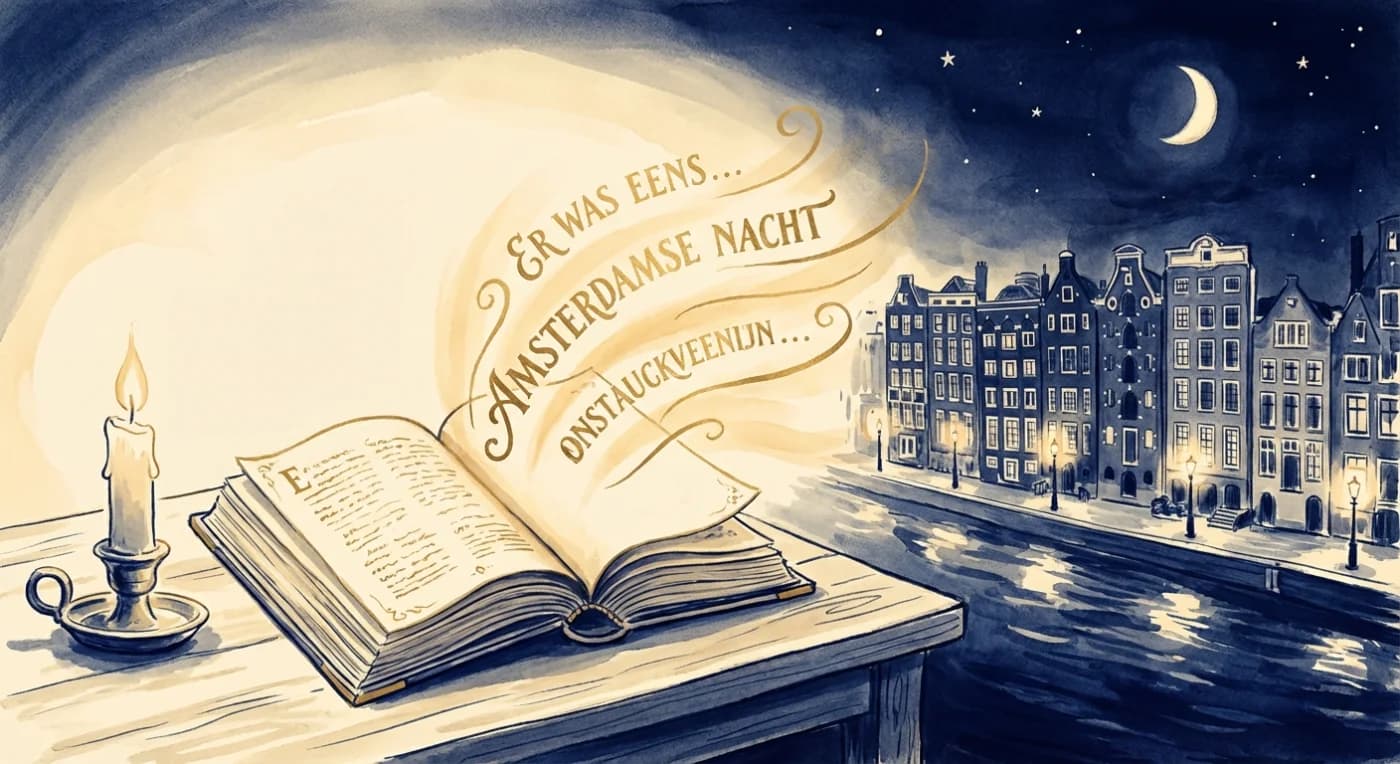
You download the app. You swipe through flashcards. Huis means house. Gracht means canal. Fiets means bicycle. You get a streak. You feel productive. Three weeks later, someone in Amsterdam says "Hoe gaat het?" and your mind goes blank.
This isn't your fault. It's the flashcard's fault. And there's good science explaining why.
The Problem with Isolated Vocabulary
Traditional language apps teach words in isolation. You see boekenkast, you see "bookcase", you tap "correct." The word enters your short-term memory, earns you a green checkmark, and exits within 48 hours.
Memory researchers call this the encoding specificity principle: information is easier to recall when the context at retrieval matches the context at encoding. A word learned in isolation has no context — so there's nothing to trigger recall in the real world.
"Boekenkast" memorized on a flashcard = a word floating in empty space.
"Boekenkast" learned as the hinged bookcase hiding Anne Frank's family for 761 days = a word anchored to a story, a building, a feeling, and GPS coordinates on the Prinsengracht.
Three Things That Actually Make Words Stick
1. Narrative Context
When you learn a Dutch word inside a story, your brain encodes it alongside characters, plot, tension, and resolution. A 2009 study in Memory & Cognition found that words learned in narrative context were recalled 1.5 to 3 times more often than words learned from lists — even weeks later.
In Wander Languages, you don't learn verzet ("resistance") from a vocabulary list. You learn it watching Victor Kugler manage a German inspector in the Opekta offices while eight people hold their breath behind a bookcase. The word becomes part of a scene you can replay in your mind.
2. Emotional Anchoring
The amygdala — your brain's emotional processing centre — sits right next to the hippocampus, the region responsible for forming long-term memories. When you feel something while learning, the emotional and memory systems fire together. The word gets tagged as important.
When you learn vreemdeling ("stranger") while reading about an 18-year-old Danish girl arriving alone in Amsterdam in 1664 — with no money, no Dutch, no job — the word carries weight. You feel her isolation. That feeling is the anchor.
3. Spatial Memory (The Memory Palace)
The Method of Loci — placing information at specific locations in a mental space — has been used since ancient Greece. Modern neuroscience confirms it: spatial context dramatically improves recall. Memory champions use it to memorize thousands of digits.
Wander Languages takes this further: every Dutch word is anchored to a real location in Amsterdam with GPS coordinates. Bijl (axe) lives on the Damrak. Kabouter (gnome) lives in the Vondelpark. Achterhuis (back house) lives at Prinsengracht 263. You can walk the route yourself — when you visit Amsterdam, the city itself becomes your memory palace.
What This Looks Like in Practice
Here's how a single word — gracht (canal) — gets taught in Wander Languages vs. a traditional app:
Traditional App
Flash: "gracht" → "canal"
Tap correct. +10 XP.
Review in 4 days.
Forget in 2 weeks.
Wander Languages
You're reading about Elsje Christiaens in 1664. She takes a room on the Damrak. The gracht outside her window is thick with masts. You see the word in a Delft Noir painting. You tap it — pronunciation plays. It's pinned to GPS coordinates. Weeks later, you walk past the Damrak and the word comes back.
291 Words, 55 Locations, 400 Years
Wander Languages currently teaches 291 Dutch words across 9 episodes and 14 Amsterdam Tales, spanning 1345 to 2026. Every word has:
- A story context — who, when, where, why
- A Delft Noir painting — hand-crafted visual for every word
- A pronunciation guide — corrected for common English-speaker mistakes
- A map location — pinned to real Amsterdam coordinates
- Spaced repetition review — SM-2 algorithm adapts to your recall speed
Episode 1 is free. No signup required. You can start learning Dutch through Amsterdam's first evening — and decide if this way of learning feels different.
Ready to start learning?
Episode 1 is free. No signup required. Just tap and begin.
Start Episode 1 Free →