Bruegel's Proverbs
The 500-year-old guide to speaking Dutch like a local.
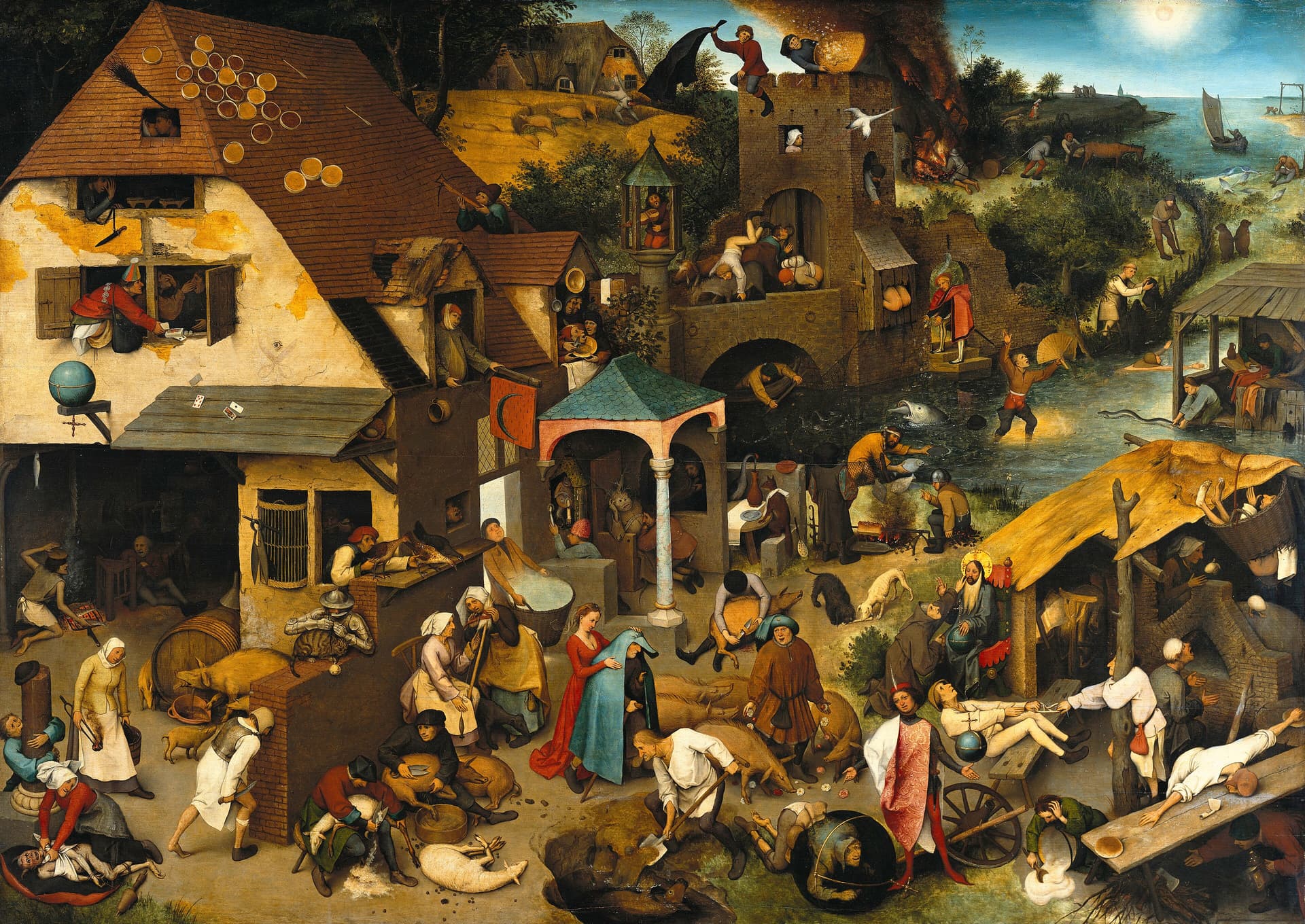
Netherlandish Proverbs · Pieter Bruegel the Elder · 1559 · Gemäldegalerie, Berlin
In 1559, a Flemish painter named Pieter Bruegel the Elder sat down and did something strange. Instead of painting a battle, or a saint, or a wealthy merchant's family, he painted chaos. A village in full, absurd motion. A man trying to fill the world with porridge. A woman hanging a blue cloak on her husband. A man biting a pillar.
The painting is called Netherlandish Proverbs. It contains 112 scenes, and each one depicts a Dutch proverb — a saying that 16th-century Flemish and Dutch people used every day. Some of those proverbs are 500 years old. And most of them are still in use.
If you want to speak Dutch like someone who grew up here, Bruegel is where you start.
What makes a proverb different from a phrase
Most Dutch language apps teach you phrases. Waar is het station? (Where is the train station?). Ik wil graag een koffie. (I'd like a coffee). These are useful. You need them. But they don't make you sound Dutch — they make you sound like someone learning Dutch.
Proverbs are different. When a Dutch colleague says "nu komt de aap uit de mouw" — literally "now the monkey comes out of the sleeve" — they're saying that someone's true motives have finally been revealed. There's no textbook phrase for that. There's no flashcard that will teach you when to use it. You learn it by hearing it used, by understanding the image, by feeling the moment it fits.
That's what Bruegel gives you. Not grammar rules. Images. Situations. Feelings.
A walk through the painting
Look at the bottom left of the painting. There's a man trying to swim against the current of a river. That's tegen de stroom ingaan — to go against the current. The Dutch still say this when someone resists conventional wisdom or fights an impossible battle. The image is so vivid that once you've seen it, you never forget the phrase.
In the centre, a man is banging his head against a brick wall. Met het hoofd tegen de muur lopen. To walk head-first into a wall. Used when someone stubbornly pursues something that will never work.
Top right: a woman draped a blue cloak over her husband's shoulders. De man een blauwe mantel omhangen. To put a blue cloak on your husband — which, in medieval symbolism, meant to cheat on him. Used today to mean deceiving someone completely.
Every image is a lesson. Every lesson is a story.
Why these proverbs still matter
Of the 112 proverbs in the painting, around 42 are still actively used in modern Dutch. Not as historical curiosities — as living language. You'll hear them in offices, on TV, between friends at the bar.
Tegen de stroom ingaan. De kat uit de boom kijken. (To watch the cat climb out of the tree — to wait and see which way things go.) Twee vliegen in één klap slaan. (To kill two flies with one swat — two birds, one stone.)
These aren't decorative phrases. They're the way Dutch people actually talk when they're not being careful. And if you can use them naturally — in the right moment, without forcing it — Dutch people notice. That's the moment you stop being a tourist and start being someone who gets it.
The Bruegel experience inside Wander
The Wander app includes a dedicated Bruegel experience in The Dutch Way — a section of the app focused on the Dutch you won't find in a classroom.
Inside Bruegel, you can explore 42 proverbs from the 1559 painting. Each one shows the original scene, gives the Dutch phrase, explains the modern meaning, and plays native-speaker audio. You can add any proverb to your review deck and Wander's spaced repetition system will bring it back at exactly the right moment.
It's not a quiz. It's not a flashcard. It's more like wandering through the painting itself, except every door you open teaches you something.
Three proverbs from the painting
De wereld op zijn kop zetten
To set the world on its head
To turn everything upside down; to cause upheaval
Met de neus in de boter vallen
To fall with your nose in the butter
To stumble into good luck; to land on your feet
Kat uit de boom kijken
To watch the cat climb out of the tree
To wait and see which way things go before committing
The deeper reason it works
There's a reason language teachers have used proverbs for centuries. It's not tradition. It's neuroscience.
Memory works by association. A single Dutch word is a single thread. A proverb — especially one anchored to a vivid image — is a net. De neus in de boter vallen connects to a physical image (someone faceplanting into butter), an emotional resonance (the absurd luck of it), and a social meaning (when you'd actually say this). Three layers, one phrase. It sticks.
Bruegel's painting works because it provides the image. It gives the phrase somewhere to live in your mind — a scene, a moment, a character acting it out. That's why we built the Bruegel experience into Wander. Not as an art lesson. As a memory system.
Try it
The Bruegel experience is part of Wander's premium plan. But Episode 1 of Wander — De Eerste Avond, set in modern Amsterdam — is completely free. It takes about 15 minutes, you'll learn 30 real Dutch words in context, and you'll understand why Wander teaches the way it does.
If you want to see the proverbs, to wander through Bruegel's village and hear every phrase spoken aloud — that's in the Dutch Way section. It's one of the parts of the app I'm most proud of.
Start with Episode 1 — it's free, no credit card
🌧️ Start Episode 1 — freeAlready have a Wander account? Go to The Dutch Way →
Ready to start learning?
Episode 1 is free. No signup required. Just tap and begin.
Start Episode 1 Free →